
Painted Shadows in the First Light
The earliest images turned memory into vision and vision into belonging
Into the chambers where silence holds color
Walk into a cavern that has slept for tens of thousands of years and you find a theater without voices, a hush that vibrates with pigments pressed by careful hands. Prehistoric art invites no applause, yet it alters anyone who stands within its reach. The walls carry herds of animals, constellations of dots, wandering lines, and hands that seem to hover like apparitions of intent. These spaces were not idle galleries. They were chosen for echo, for darkness, for the way light from a small flame awakens movement upon stone. When flame trembles, the painted bison appears to breathe, the horse seems to stamp, the aurochs leans into an invisible wind. Such illusions tell us that artists understood the choreography of perception, a craft that joins observation with performance. Minerals ground into powders mixed with fat or plant binders gave colors that endure beyond memory. Iron oxides smile as reds and browns, manganese offers deep black, calcite gives gentle brightness. The choice of pigment mattered less than the choice of place. The artist worked within a sanctuary of rock, not in open day, which suggests that the act of painting involved intention that surpassed decoration. These images are lessons in patience, in attention, in how imagination meets endurance. They show that long before letters were carved into clay, the human mind sought a stage for its visions and found it in the breathing stone of the earth.
The hand as signature and presence
Among the oldest images left by human beings are hand stencils that bloom like pale stars across cave walls. A mouthful of pigment blown around a pressed palm leaves a negative form, a halo of being. The gesture is simple, yet it speaks across time with startling intimacy. Here is a person who reached out to rock, made contact, and chose to leave a record of that contact. The hand is not only a tool maker. It is also a narrator. Fingers splayed or held close, sometimes missing tips, sometimes adorned with dots or small signs, the handprint stands as a witness that refuses to fade. Scholars debate whether these stencils mark identity, ritual participation, counts of individuals, or a kind of initiation. The answer may be all of these at once. A single hand can serve as oath, as boundary, as blessing. Where animals gallop and swirl, the hand anchors the scene in the human body. It declares, I am here, I see, I remember. The negative form also inverts the idea of self. To create it one must cover the hand not with paint but with absence and let the stone receive the color instead. Presence emerges from what is not colored. In this reversal we glimpse a philosophy that values relation over object. The rock completes the person, the person awakens the rock. The print becomes both signature and bridge, a proof of touch that folds distance into closeness.
Animals as teachers and mirrors
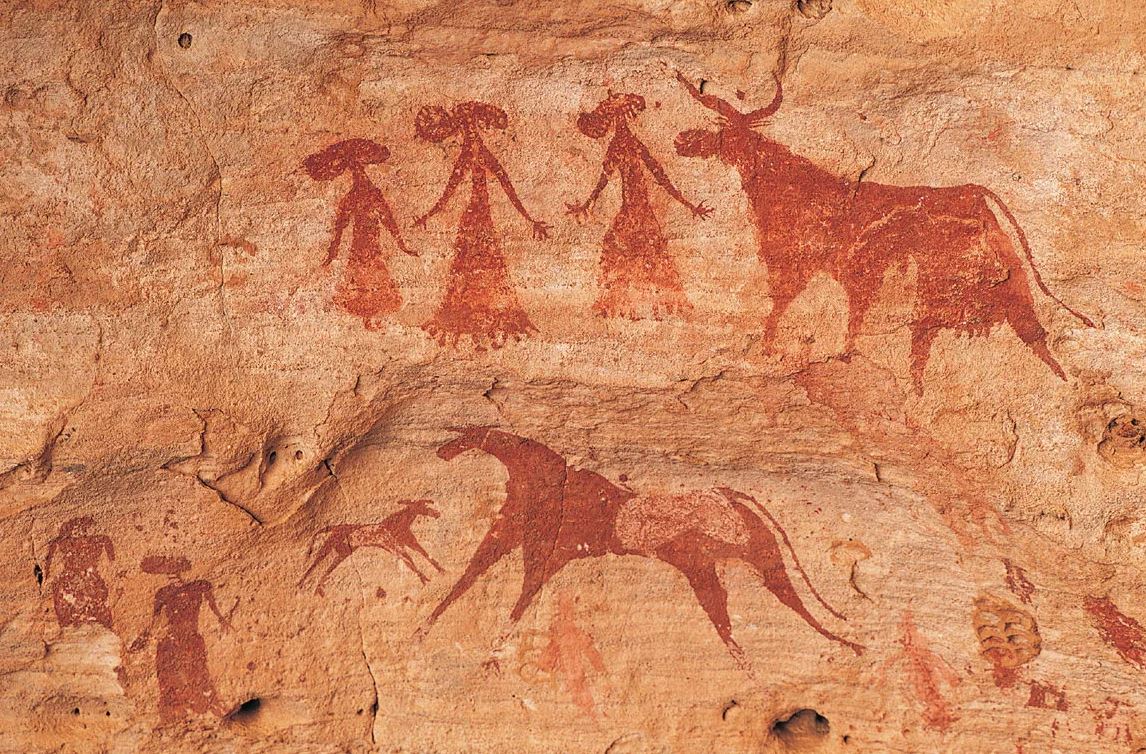
The centers of many caves teem with animals that once fed, clothed, and instructed early communities. Bulls lower their heads with power and weight, deer leap with a grace that turns stone into open field, lions pace in a hush that bends the air. To paint an animal is to study it, to rehearse its posture, to anticipate its path. Prehistoric art shows attention sharpened by dependence and admiration. Hunters learned habits through watching, then they preserved those lessons in pigment. Yet the images rarely show simple scenes of capture. The action is more dreamlike, as if the animal moves inside two worlds at once, the world of pursuit and the world of symbol. This double movement suggests that animals served as models for qualities that communities cherished. Strength, speed, patience, and endurance anchor the scenes, but so do nurturing and protection. A mare with a foal recurs in some regions, a reminder that survival depends on renewal as much as on skill. Artists understood proportion, outline, and overlap. They placed forms so that one figure covers another without erasing it, which turns the wall into a layered memory. This layered approach hints at repeated visits, at a tradition of return, at a long dialogue between people and place. The cave becomes a living archive where animals carry both sustenance and story, where every painted body holds a lesson that refuses to vanish with the season.
Materials, methods, and the choreography of light
To bring images into darkness demanded invention across many steps. Stone served as canvas, but it required preparation. Some surfaces were scraped to smoothness, others were chosen for natural curvature that could cradle the roundness of a flank or the thrust of a horn. Pigments came from veins of mineral dug with patience from hillsides, then crushed, sifted, and mixed with water, marrow, blood, or plant gum to form workable pastes. Brushes could be fashioned from chewed twigs, hair bundles, or feathers, and lines could be drawn with sharpened bone or charcoal sticks. Stencils used hollow bones as blowpipes, a breath that coats the edges of a pressed palm or a carved mask. Engraving added texture where paint was thin, and incised lines caught low light like threads of silver. Illumination was a craft in itself. Stone lamps filled with animal fat held small flames that could be carried or set upon ledges. The painter moved with the flame and the flame moved with breath and draft, so the image unfolded in a dance of shifting shadows. Some figures sit where the rock bulges, which turns anatomy into relief. Others curve with the roof so that a slight tilt of the lamp makes them advance or retreat. Art in this world was not static. It arose from a conversation between body, fire, and stone, a conversation that required patience and trust in the stubbornness of matter.
Counting, mapping, and the first signs of time
Beyond animals and hands, caves carry sequences of dots, ladders, grids, and curious branching lines. These signs may look abstract at first glance, yet they hold the promise of intention. Some scholars propose that clusters of marks correspond to seasons or lunar cycles. Others see pathways, territorial cues, or teaching tools for young hunters. Whatever their precise purpose, such patterns prove that people sought to chart change and to remember its rhythm. Prehistoric art becomes a calendar, a map, and an instruction at once. A sequence of dots near a herd may record observations about migration. A ladder beside a feline may preserve a story about danger and safe conduct. The act of marking regularity on stone teaches that time can be made visible. Once time is visible, foresight becomes possible in a new way. The wall becomes a board for thinking, a surface where groups can anchor ideas that exceed private memory. This habit of mapping lies at the root of later writing and measurement. It begins with patience, with attention to cycles, with the desire to share foresight. The painted chamber therefore holds not only beauty but also a science of pattern. It is an early classroom where observation turns to symbol, and where symbol folds back into action, guiding herds, seasons, and journeys so that a community can flourish rather than drift.
Ritual, voice, and the acoustics of belonging
Caves chosen for imagery often have remarkable acoustics. A clap carries far, a hum circles back like a friend returning, a chant thickens the air. This acoustic power suggests that images worked with sound rather than apart from it. Picture a group entering with lamps, voices rising, drum or bone flute finding a steady pulse. The painted animals flicker as the flame wavers, and the chamber responds with echoes that break one voice into many. Ritual would bind these elements into a shared act. Movement and chant, pigment and flame, breath and rock become a single weave. Participation matters more than spectatorship. By repeating song and gesture in the presence of painted beings, the group renews its sense of origin and promise. Children see the animals come alive and learn both caution and admiration. Adults remember hunts, losses, and gifts that keep the group together through winter. The cave becomes a contract shaped by repetition. In this sense prehistoric art is not only visual. It is performative. The performance educates heart and mind. It transforms fear of darkness into a mastery of darkness. It trains attention, builds trust, and carves pathways of memory that guide behavior outside the cave. When the group leaves, a residue of harmony remains, and that harmony continues to shape speech, exchange, and care beneath the open sky.
Portable beauty and the trail of intimate objects
Not all art stayed within stone chambers. People carried engraved bones, carved figurines, decorated tools, and beads that turned the body into a walking canvas. These portable works compress the vastness of the cave into objects that join daily life. A line etched along a spear thrower does more than please the eye. It instructs the hand to align with rhythm. A pendant of shell or tooth travels far from its ocean or forest, a sign that exchange linked groups across distance. Beads stitched into clothing turn movement into light, a shimmer that speaks before words arrive. Figurines with prominent features, whether human or animal, condense fertility, power, or protection into forms that fit within the palm. Such intimacy changes how meaning circulates. Instead of waiting for a gathering in darkness, a person could carry remembrance at all hours. Portable art is also a record of travel. Materials reveal paths of contact. A piece of amber found deep inland tells of journeys or trade that tied rivers to coasts and hills to plains. The object becomes both token and story. It holds a fingerprint of a maker and a trace of a route. Through these small things, prehistoric art seeps into every gesture, shaping identity with grace that moves wherever people move.
Continuity, change, and the ethics of looking
To study prehistoric art is to accept responsibility for attention. We look into worlds that were not made for us, yet they call us with force. Respect begins with patience and with the refusal to rush toward certainty. Every interpretation must remain open to revision because new findings often transform the field. What endures is the recognition that these works cultivate community across time. They do so by honoring perception, by rewarding care, by inviting humility. Many modern artists and thinkers find guidance in these places. The lessons are practical and moral. Work with the grain of your material. Let light be a partner rather than a servant. Trust the slow accumulation of detail. Remember that beauty without relation cannot endure. Museums and conservators face their own burden. Pigment that lasts for ages can fade quickly under careless light, and footsteps can seed moisture that harms walls. Protection requires limits on access, careful replication, and patient documentation. The goal is not to hoard but to sustain. We preserve so that future eyes can practice the same patience, so that future voices can sing in chambers that still answer. In keeping this dialogue alive we also protect our own capacity for wonder, which is perhaps the first and last gift that prehistoric artists place into our hands.
What the first images still ask of us
The birth of art did not occur to entertain an audience. It arose from the need to hold meaning steady, to teach, to remember, and to belong. The painted cavern, the carved bone, the woven bead, each made the world more intelligible, more habitable, more filled with relation. These works reveal a practice of attention that modern life risks forgetting. They teach slow seeing. They ask for reverence without dogma. They provide knowledge that has no single owner. When we study them carefully we notice that technique and tenderness grow together. Hands knew the resistant patience of stone, minds knew the moving patience of time. The result is clarity that refuses to age. Prehistoric art still works because it honors the conditions of life that have never changed. People need memory, rhythm, guidance, and courage. People thrive when they share vision in forms that invite the whole body to understand. The first artists found a way to answer these needs with color, breath, and rock. Their answers remain persuasive without arguing. They simply stand in darkness and shine when we arrive with light. If we carry that light with gentleness, then the painted shadows continue to move, and we move with them, joined to a lineage of care that begins before names and continues wherever a human hand reaches for meaning.